This is usually one of the last questions before an order is confirmed.
Not about design.
Not about style.
But something more practical — whether everything will actually work once it is installed in a real space.
So before anything is confirmed, it is important that the dimming system is clearly understood and aligned.
In most residential projects we work with, TRIAC is already the standard setup. It is simple, stable, and widely used in home environments.
At this stage, there is often one common misunderstanding worth clarifying.The dimming system is not chosen based on chandelier size or the number of light heads. And it is also not directly about “how powerful the chandelier is”.
What actually matters is the electrical system already prepared in the building, and the way the lighting is meant to be controlled.
For example, a large chandelier does not automatically require a more complex system. If it is installed in a residential space with a standard wall dimmer, TRIAC is still the correct solution.
However, when the number of light heads becomes very large, the situation changes not because of design, but because of electrical load.
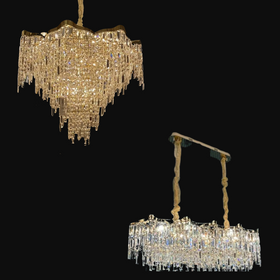
Each light head adds to the total operating power of the chandelier. When a fixture contains around 200 light points, like some of the large crystal chandeliers we have produced before, the total load can easily exceed what a standard TRIAC dimmer is designed to handle. At this point, the issue is no longer about dimming preference, but system capacity.
In one real project we worked on, the total load went beyond the capacity of a typical residential TRIAC system. As a result, the chandelier could still light up, but the system became unstable — flickering occurred, dimming was inconsistent, and in some cases, the fixture could not start properly.
This is not about the chandelier itself, but about the limit of the dimming device behind the wall.
Most residential TRIAC dimmers also have clear load ratings, typically around 300W, 600W, or 1000W depending on the model. In many of our standard projects, the 600W-rated version is commonly used.
Once the total load of the chandelier exceeds this limit, the system is no longer able to operate smoothly, and a different control solution such as 0–10V or DALI becomes necessary.
On the other hand, even a medium-sized fixture may require DALI or 0–10V if the project itself is built around a centralized lighting control system.
That is why the system is always defined by the project — not by the fixture.
That said, every project is slightly different.
In architectural or larger-scale spaces, we often see DALI systems used for more centralized lighting control, especially in hotels and commercial interiors. In some cases, 0–10V or other custom control systems may also be involved.
When needed, we adjust the driver during production so the fixture matches the system it will be used with. Custom requirements are always possible.
If you are not sure about your system, that is absolutely fine. Most clients are not electricians. A quick photo of your wall dimmer, or a short check with your electrician, is usually enough. We can confirm it together from there.
![]()
You also mentioned the installation guide.
To keep things simple on site, we prepare everything in advance so your electrician doesn’t need to figure things out during installation. This includes dimmable bulbs, and a dedicated installation guide made specifically for your fixture, with clear wiring and assembly instructions.
![]()
![]()
We really appreciate the opportunity to work with you, and to be considered among so many chandelier brands.
We really value that trust.
![]()
And we try to respond to it in the most honest way we can — in both design and execution!