CALL US
+1 (213) 284-1270
+1 (213) 284-1270

When selecting a large luxury chandelier, most people focus on design, crystal quality, or visual impact. While aesthetics are essential, there is another factor that should always come first - Structural Safety.

In high-end residential and hospitality projects, lighting is never treated as a lightweight decoration. It is treated as a structural element. And for good reason.
Through our long-term collaboration with CSA-certified teams, Lyfairs has had extensive experience producing lighting fixtures that meet CSA requirements for Canadian projects.
It is through this ongoing cooperation with CSA professionals that we gained deeper insight into how structural safety is evaluated in international lighting standards. According to CSA professionals and international installation standards, ceiling structures are often engineered with significant safety margins—sometimes designed to support multiple times the actual weight of the lighting fixture.

This margin exists for a reason. Chandeliers are not static objects—over time, vibration, installation tension, temperature changes, and material fatigue all affect structural performance. A chandelier that weighs 30 kg today should be supported by a ceiling system engineered to safely handle significantly more than that weight to ensure long-term stability and safety.
In practical engineering terms, a conservative and safer guideline is this:
The ceiling support system should be rated for at least 1.5 times the chandelier’s weight.
For example, if a chandelier weighs 30 kg, the ceiling structure should be able to support at least 45 kg or more.
This safety margin is not a luxury; it is a necessity.
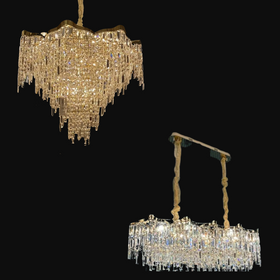
Large chandeliers are statement pieces. They often feature layered metal frames, crystal components, multiple arms, and complex suspension systems. These elements add not only visual presence but also real weight.

When lower-cost chandeliers are produced using cheaper alloys, thin metal frames, or substandard internal structures, two serious issues arise:
Structural risk increases
Inferior materials may bend, fatigue, or fail under long-term load, even if the chandelier appears visually impressive at first.
The overall quality of the space is diminished
Luxury interiors rely on coherence—materials, craftsmanship, and engineering must all align. A poorly made chandelier instantly lowers the perceived value of the entire home, no matter how beautiful the rest of the decor may be.
Quality Is More Than Appearance—It Is Engineering
True luxury lighting is designed from the inside out.

At the high end of the market, chandeliers are engineered with:
Reinforced internal frames
Proper weight distribution
Reliable hanging and suspension systems
Materials chosen not just for beauty, but for durability and load performance
This level of construction ensures that the chandelier can be safely installed, confidently enjoyed, and preserved for years—often decades.
It can be tempting to choose a lower-priced chandelier that looks similar at first glance. But in large-scale lighting, price differences often reflect material integrity, internal structure, and safety standards, not just brand markup.
Cutting costs usually means:
Thinner metals
Weaker joints
Reduced safety margins
Shorter lifespan
In the context of a refined home, these compromises are not invisible—they are felt.
A luxury chandelier should elevate a space in every sense—visually, emotionally, and structurally. When properly designed and installed, it becomes a focal point that enhances the home’s character and long-term value.
When choosing a large chandelier, always ask:
Is it engineered with safety in mind?
Are the materials chosen for strength as well as beauty?
Does it respect the standards required for high-end residential spaces?
At Lyfairs, we believe that quality starts within the structure itself. After all, safety is an essential component of luxury.

{"one"=>"Seleziona 2 o 3 articoli da confrontare", "other"=>"{{ count }} di 3 elementi selezionati"}
Seleziona il primo elemento da confrontare
Seleziona il secondo elemento da confrontare
Seleziona il terzo elemento da confrontare